
Syringes/Needles/Sharps

Syringes, Needles, and Sharps Supplies for Skilled Nursing, DME, and Home Care Providers
Geriatric Medical supplies syringes, needles, and sharps disposal products in wholesale volumes to skilled nursing facilities, long-term care communities, DME/HME providers, and home care and home infusion agencies nationwide. Our catalog includes syringes with and without needles, hypodermic needles, insulin syringes, IV flush syringes, IV administration and dressing kits, IV cannulas and blood collection supplies, and sharps containers, so your nursing team can source injection and IV supplies from one distributor.
Whether you're stocking medication carts, supporting residents on insulin or IV therapy, or supplying clinicians in the field, our team can help you match syringe sizes, needle gauges, and safety features to your protocols and order volume.
Syringe, Needle, and Sharps Questions from Providers
What syringes, needles, and sharps supplies does Geriatric Medical carry?
We carry syringes with needles, syringes only, needles only, insulin syringes, IV flush syringes, IV administration and dressing kits, IV cannulas and blood collection supplies, and sharps containers. For IV fluids and sterile solutions, see our solutions and IV category.
What do needle gauge and length mean?
Needle gauge refers to the needle's diameter, and a higher gauge number means a thinner needle, so a 25-gauge needle is thinner than a 22-gauge needle. Length is measured in inches or millimeters. The right combination depends on the injection route, the medication, and the patient's size. As a general reference, CDC vaccine administration guidance lists 22 to 25 gauge needles at 1 to 1.5 inches for adult intramuscular injections and 23 to 25 gauge needles at 5/8 inch for subcutaneous injections. Always follow the medication's instructions and your facility's protocols.
Are safety needles and syringes required?
OSHA's Bloodborne Pathogens Standard, as updated by the Needlestick Safety and Prevention Act, requires employers to evaluate and use safer medical devices, such as needles and syringes with engineered sharps injury protection, to reduce needlestick injuries. Employers must also involve frontline staff in evaluating and selecting these devices and review their exposure control plan annually. Safety features include retractable needles, hinged or sliding needle shields, and needleless connectors.
What's the difference between Luer lock and Luer slip syringes?
Luer lock syringes have a threaded tip that twists onto a needle or connector for a secure connection that won't come loose, which is preferred for IV connections and when drawing up or injecting under pressure. Luer slip syringes have a smooth tip that the needle or connector pushes onto, which makes them quick to assemble for routine injections. Both are available with or without attached needles.
How do we choose the right insulin syringe?
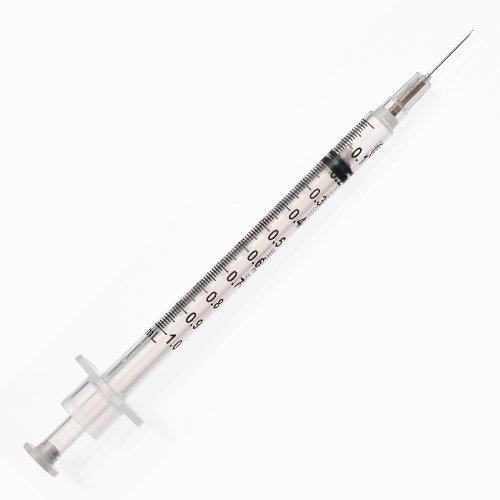
Insulin syringes are marked in units rather than milliliters, and U-100 syringes are designed for U-100 insulin, the most common concentration. They're available in 0.3 mL, 0.5 mL, and 1 mL sizes. Choosing the smallest syringe that holds the full dose makes small doses easier to measure accurately, and some smaller syringes include half-unit markings. Insulin syringes also come with short, thin needles for subcutaneous injection. The syringe must match the concentration of the insulin being given.
How do we choose the right syringe size?
Syringes are sized by capacity, commonly ranging from 1 mL to 60 mL. For accurate measurement, choose the smallest syringe that holds the full volume being given. Tuberculin syringes, which are 1 mL with fine graduations, are used for very small doses. Larger syringes are used for irrigation, feeding, and flushing, and syringes with an ENFit tip are required for enteral feeding tubes rather than standard Luer syringes.
Why use prefilled IV flush syringes?
Prefilled saline flush syringes are used to flush IV catheters before and after medication administration to keep the line clear and prevent medications from mixing. Because they come ready to use, they save time and reduce the contamination risk that comes with drawing up flush solution from a vial. Flushing technique, volume, and syringe size should follow your facility's IV policy and the catheter manufacturer's guidance, and many IV policies call for a 10 mL-diameter syringe for flushing to avoid excessive pressure on the catheter.
What's included in IV start kits and IV dressing change kits?
IV start kits bundle the supplies needed to place a peripheral IV, which commonly include a tourniquet, antiseptic skin prep, gauze, tape, and a transparent dressing. IV and central line dressing change kits typically include antiseptic applicators, sterile gloves, a mask, gauze, and a transparent dressing. Kit contents vary by manufacturer, so check each listing for components. Kits standardize the procedure and save staff time gathering individual supplies.
What blood collection supplies do facilities and home health providers use?
Common blood collection supplies include evacuated blood collection tubes, tube holders, multi-sample needles, winged blood collection sets (sometimes called butterfly needles), tourniquets, and labels. Winged sets are often preferred for older adults with small or fragile veins. Tube types are identified by cap color and additive, and staff should follow the laboratory's requirements for tube selection and order of draw. Blood collection tubes have expiration dates, so rotate stock to avoid using expired tubes.
How should sharps containers be used and replaced?
Sharps containers should be puncture resistant, leak resistant on the sides and bottom, and closable, and they should be placed at the point of use so used needles can be discarded immediately without recapping. Containers should be replaced when they reach the fill line, typically about three-quarters full, and should never be overfilled. Disposal of full containers must follow your state's regulated medical waste requirements. Smaller containers are available for med carts and home care patients.
Can we order syringes, needles, and sharps supplies through EDI or a punchout catalog?
Yes. Geriatric Medical supports EDI ordering and punchout catalog integration for accounts that manage purchasing through their own procurement, EHR, or ERP systems, so syringes, needles, IV supplies, and sharps containers can be ordered the same way as the rest of your catalog without manual re-entry.