
OTC/Vitamins

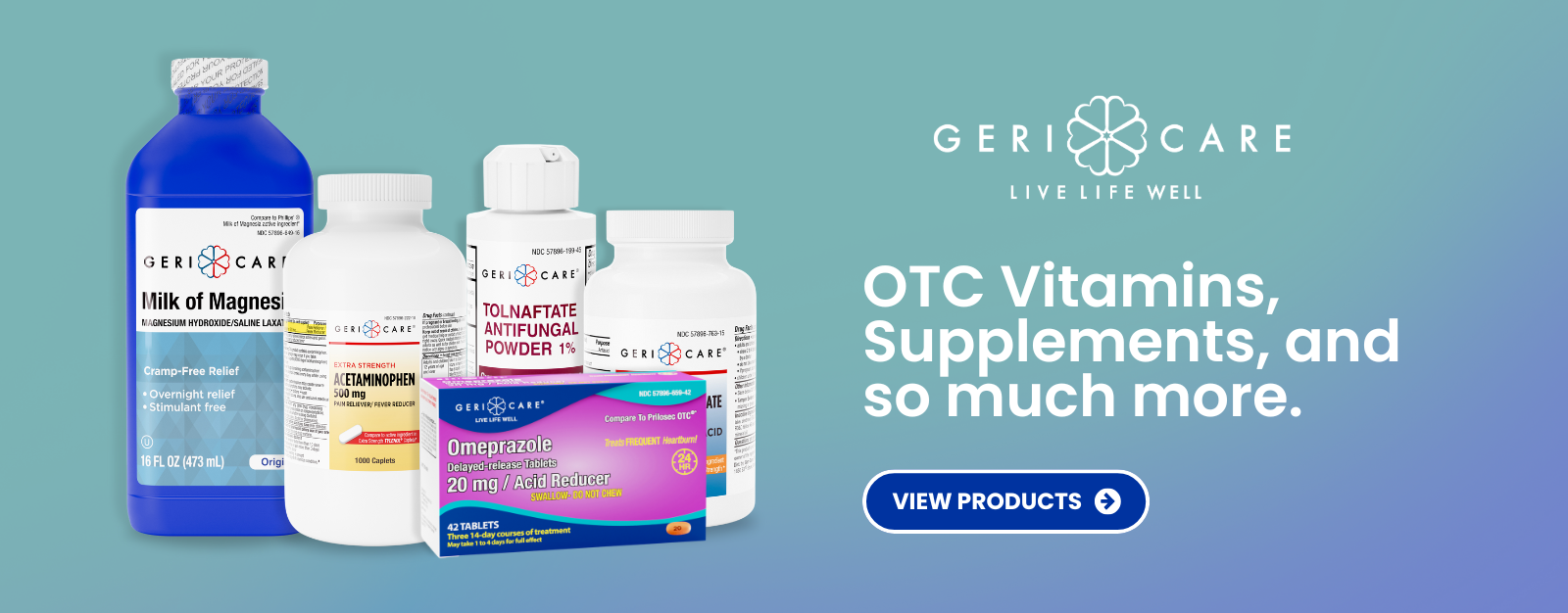
OTC Medications and Vitamins for Skilled Nursing, DME, and Home Care Providers
Geriatric Medical supplies over-the-counter medications, vitamins, and medication aids in wholesale volumes to skilled nursing facilities, long-term care and assisted living communities, DME/HME providers, and home care agencies nationwide. Our catalog includes pain relievers and topical analgesics, vitamins and minerals, digestive health products, cough, cold, and allergy medications, ear and eye care, foot care, smoking cessation products, and pill crushers and other medication helpers, so your team can source OTC products alongside the rest of your supplies from one distributor.
Whether you're stocking OTC products for your med carts or supplying patients at home, our team can help you find the products, package sizes, and formats that fit your medication pass and order volume.
OTC and Vitamin Questions from Providers
What OTC medications and vitamins does Geriatric Medical carry?
We carry pain relievers and analgesics, pain patches, gels, and ointments, vitamins and minerals, laxatives and anti-diarrheals, antacids, gas relief, and anti-nausea products, cough, cold, and allergy medications, ear and eye care, hemorrhoid treatments, foot care, smoking cessation products, and pill crushers and medication helpers.
Do nursing homes need a physician order to give residents OTC medications?
Generally, yes. In skilled nursing and long-term care facilities, OTC medications are typically administered according to a physician or prescriber order, just like prescription medications, and they're documented on the resident's medication administration record. Rules for keeping OTC products as house stock vary by state and facility policy, so work with your consultant pharmacist to confirm what applies to your facility.
Are some OTC medications risky for older adults?
Yes. Some common OTC ingredients carry higher risks for older adults. For example, first-generation antihistamines such as diphenhydramine, found in many allergy, cold, and sleep products, are listed in the American Geriatrics Society Beers Criteria as potentially inappropriate for older adults because they can cause confusion, sedation, and falls. Facilities and providers should review OTC selections with a pharmacist or prescriber, especially for residents taking multiple medications.
Are store-brand OTC medications as effective as name brands?
Store-brand or generic OTC medications contain the same active ingredients at the same strengths as their name-brand equivalents and must meet the same FDA requirements for OTC drugs. Differences are usually limited to inactive ingredients, packaging, and price. Many facilities standardize on store-brand OTC products to control costs, while keeping specific brands available when a prescriber orders them.
Which medications should not be crushed with a pill crusher?
Extended-release, sustained-release, and enteric-coated medications, along with some others, generally should not be crushed, because crushing can release the full dose at once or destroy the coating that protects the drug or the stomach. The Institute for Safe Medication Practices (ISMP) publishes a widely used "Do Not Crush" list. Staff should check with a pharmacist before crushing any medication they're unsure about, especially for residents with swallowing difficulties or feeding tubes.
What medication helpers do facilities and home care patients use?
Common medication helpers include pill crushers for residents who have trouble swallowing, pill cutters for splitting scored tablets, pill crusher pouches that keep crushed medication contained and reduce cross-contamination between residents, and pill organizers for patients managing their own medications at home. Pill pouches are designed to be single-use, which supports infection control during medication pass.
What should we look for when choosing vitamins and supplements?
Vitamins and dietary supplements aren't approved by the FDA the way medications are, so product quality can vary between manufacturers. Look for products that carry a third-party verification mark, such as USP Verified, which indicates the product has been tested for ingredient identity, strength, and purity. Commonly ordered supplements in senior care include multivitamins, vitamin D, calcium, and vitamin B12, typically given according to a prescriber's order.
What are the differences between types of OTC laxatives?
OTC laxatives work in different ways. Stool softeners, such as docusate, add moisture to stool. Bulk-forming laxatives, such as psyllium, add fiber and require adequate fluid intake. Osmotic laxatives, such as polyethylene glycol and milk of magnesia, draw water into the bowel. Stimulant laxatives, such as senna and bisacodyl, trigger bowel contractions. Bowel regimens in facilities are typically part of a resident's care plan and follow the prescriber's order.
What's the difference between topical pain relievers and oral pain relievers?
Topical pain relievers, such as patches, gels, creams, and ointments, are applied directly to the skin over the painful area and are often used for localized joint and muscle pain. Common active ingredients include lidocaine, menthol, and diclofenac. Oral pain relievers, such as acetaminophen, ibuprofen, and naproxen, work throughout the body. Topicals are frequently used for older adults with localized pain, but product selection should follow the prescriber's order and product labeling.
What foot care products are commonly used in senior care?
Common foot care products include moisturizing creams for dry or cracked heels, antifungal treatments, corn and callus cushions, and protective pads that reduce friction and pressure. Foot care is especially important for residents and patients with diabetes or poor circulation, who should have their feet checked regularly and be referred to a podiatrist or clinician for any wounds, sores, or signs of infection.
What smoking cessation products do you carry?
We carry nicotine replacement therapy products such as nicotine patches, gum, and lozenges. Patches provide a steady dose of nicotine throughout the day, while gum and lozenges can be used to manage cravings as they come up. Some people use a combination of products under the guidance of a clinician. These products can support residents, patients, and staff who are working to quit smoking.
How should OTC medications be stored and rotated in a facility?
OTC medications should be stored according to the temperature and storage directions on the label, in a secure medication room or cart following your facility's policy. Every product has an expiration date, and expired medications should be removed and disposed of according to your facility's medication disposal procedures. Rotating stock so the oldest lots are used first helps reduce waste from expired products.
Can we order OTC medications and vitamins through EDI or a punchout catalog?
Yes. Geriatric Medical supports EDI ordering and punchout catalog integration for accounts that manage purchasing through their own procurement, EHR, or ERP systems, so OTC medications, vitamins, and medication helpers can be ordered the same way as the rest of your catalog without manual re-entry.